It’s interesting how much we take for granted when it comes to the design of the objects we interact with on a daily basis.
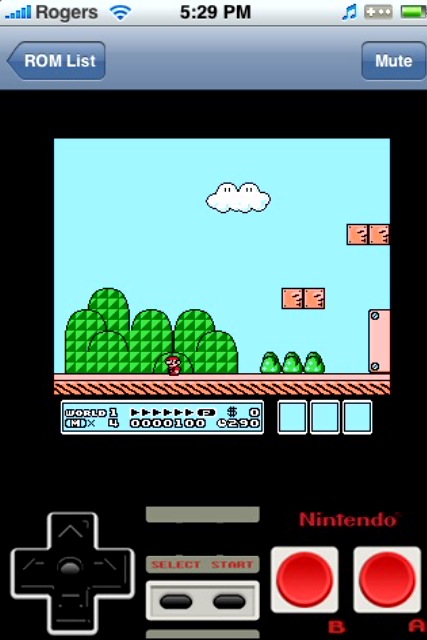
After jailbreaking my iPhone yesterday (!!!) I installed the Nintendo original NES emulator. Which is awesome in theory — it’s nice to see my old friends Elevator Action, Super Mario Brothers, Metroid, Rad Racer, etc. again. But there’s a problem: the games are almost impossible to play.
NES Emulator for iPhone
When we were using the original NES controllers I, for one, took for granted the fact that you get (and need) tactile feedback when you’re playing those games. When you’re playing Spy Hunter you’re getting contstant feedback from your left thumb — as to when you’re pushing ‘left’ vs when you’re pushing ‘up’. On the iPhone you don’t get that feedback — it’s just a flat surface.
The designers of the emulator tried to compensate for this by giving you visual feedback (there’s a little readout that tells you explicitly when you’re pushing up vs pushing left). But this doesn’t solve the problem becaue it’s giving you cues that are a) not in the most relevant medium (visual instead of tactile — which slows down your reaction time) and b) not in a relevant part of the screen (you’re looking where the action is — not where your fingers are. If you’re looking at your fingers to see where they’re pushing you’re in danger of having a Metroid suck off your face).
Old School NES
All of this, in my ‘I took Psychology of Perception 10 years ago so I totally know what I’m talking about’ kind of way, is to say that Nintendo did something right when they made those controllers. We needed the little raised + of the directional pad (the edges, the clear spatially mapped directions, etc) to input directional data and get the kind of relevant feedback we need to play the game.
The things we take for granted…
Maybe next time we’ll talk about Nintendo Synesthesia (although maybe Rad Racer’s pseudo-3D is as close as most of us come to that… ).
Is this safe? Probably. I’m sure it violates some terms of some contract I signed somewhere. But I have to say — given the seemingly unlimited possibilities for application development that are realized in the jailbroken world — the folks at Apple are being incredibly lame in their furious protection of the iPhone App world. Don’t believe me? Take a look around to see what applications you can get when your iPhone has been jailbroken. Like Snapture — that makes the camera acually useful.
I know Apple wants to be careful. Yes. If they didn’t have rules for what could and could not make it into the App Store the whole thing would have the potential to turn into the wild west. But there’s got to be a middle ground. Right now I’d say about 95% of the applications in iTunes are TOTALLY WORTHLESS. Who on earth needs another version of Sudoku? Some of the thigns there don’t even work (I’m looking at you AOL Instant Messenger!).
And I’m sure Apple has reasons behind what they reject from the App Store. And they have rules for software development that some of these people are bending. But I wish they’d loosen their grip a little. Some of the things 3rd party developers are dreaming up are so much more innovative and useful than anything a developer could make given their current SDK rules.
Chill out, Apple. You’re totally going to win and you know it. Relax. And maybe think about letting some of the big kids play in the playground too.
This came up in the blogosphere a long time ago — but it’s still funny.
At Giants Statium in San Francisco, Yahoo owns the ad next to the outfield marker for 404′.
If you spend a fair amount of time on the web, you’ll know that 404 is the server error code that is returned by a webserver when the page is not found.
This used to be just a funny coincidence, but it’s gotten to be kind of sad lately with the disintegration of Yahoo! over the past few months.
But it’s still gives me a bit of a chuckle that a web company owns an ad next to something that says 404.
I know there are people out there who don’t like Star Wars. I also acknowledge there have been far too many art projects online lately that involve people dressing up in various Star Wars costumes and posing for ironic effect. But I really like this one:
I came across a post on CrunchGear about some University of Washington students experimenting with a new video manipulation technique using still photographs to enhance or alter video.
The results are unreal. Check this out:
Did you see the part where they used a layer mask to remove a No Parking sign? That would usually take forever to do in After Effects.
Aegir Hallmundur from the Ministry of Type has a fascinating article on the math that goes into making geometric patterns on currency. The math is definitely way above my head, but it’s interesting to think about the detail that goes into making money look the way it does — including anti-counterfeiting ‘flaws’ that are introduced into the patterns.
From the Ministry of Type
This got me tinking a little more about all of the techniques that go into making money more difficult to counterfeit — and counterfeiting in general. As color printing has evolved, it’s become harder and harder for the Treasury to make bills with details that could not be replicated when the bills were scanned and printed. To help curtail counterfeiting, I know that the Treasury has worked with printer manufacturers and providers of image editing software to make sure their technology doesn’t allow users free reign to make high-quality fake currency.
You learn all sorts of fun facts when you start digging into this stuff. A friend of the family who works as a consultant to the Treasury Department on anti-counterfeiting once told us just how many points of reference there are in a banknote. I can’t remember precisely how many, but it’s a lot. She also said that nearly all $100 bills in circulation have traces of cocaine on them.
Fascinating.
More fun currency morsels:
Browse through Wikipedia for more on counterfeiting
Read up on how to detect fake currency from the source – the Secret Service
Visit Crane’s Paper — providers of US Currency paper for over 200 years